A Song of Ice and Plasma: The Formation and Behavior of Ice-Dusty Plasmas, from the Laboratory to the Edge of the Universe
Author: Nicolov, André
Year: 2026
Degree: Dissertation (Ph.D.)
Advisor: Bellan, Paul Murray
Committee Members: Goddard, William A., III; Troian, Sandra M.; Blake, Geoffrey A.; Bellan, Paul Murray
Option: Applied Physics
DOI: 10.7907/adns-n036
Abstract
Much of the universe is partially ionized by stellar radiation, x-rays, or cosmic rays, forming weakly-ionized plasma. Many of these environments are also extremely cold, from Earth’s upper atmosphere to planetary rings, protoplanetary disks, and interstellar clouds. Within these conditions, small grains of ice and dust can form and acquire electric charge by collecting free electrons and ions from the plasma.
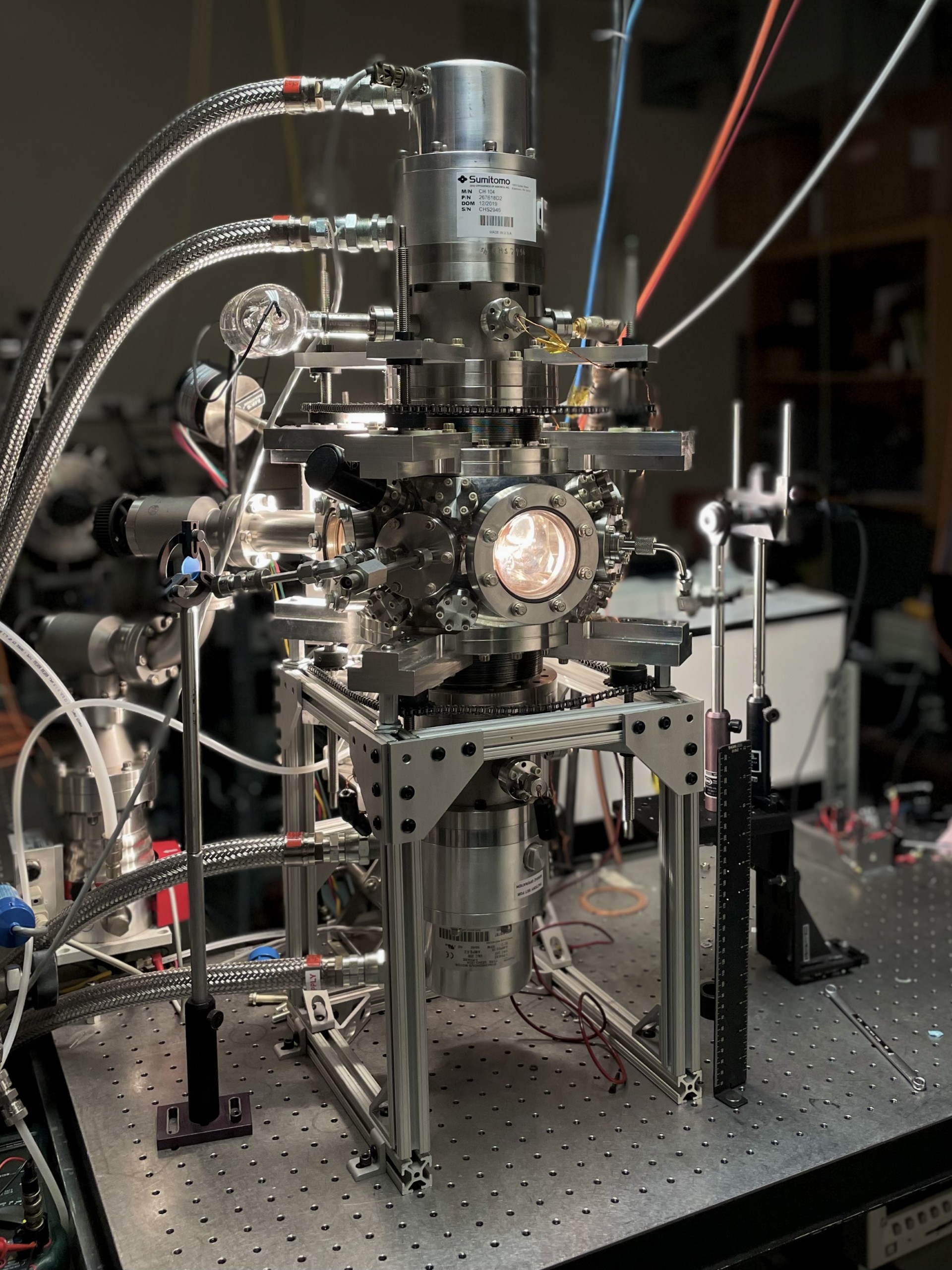
This thesis investigates these ice-dusty plasmas in the laboratory, observing the nucleation, growth, and dynamics of water-ice grains within extremely cold plasma. It details the construction and operation of a steady-state radio-frequency plasma in which the electrodes are cryogenically cooled by tandem cryostats; water vapor injected into the plasma spontaneously nucleates into ice grains which grow in dendritic fractal shapes to millimeters in length. Their electric charges confine them to the plasma, where they exhibit complex dynamics such as vortices, lattices, and instabilities.
Notably, ice grains nucleate homogeneously within the plasma: OH⁻ and H₃O⁺ ions, formed by reactions between water vapor and free electrons, attract water molecules via ion-dipole interactions to produce stable, electrically-charged molecule clusters that rapidly grow into ice grains. This process occurs regardless of the ice phase: amorphous ice forms at lower temperatures and transitions irreversibly to crystalline ice at higher temperatures or over time, mirroring processes seen in solar system ices. Further experiments reveal that the complex dynamics of the cloud of ice grains are strongly influenced by their fractal morphology, as the scaling laws of their masses, surface areas, and electric charges are vastly different during fractal growth. This allows them to strongly couple with ambient gas, enhancing momentum transfer between the grains and their surroundings and significantly increasing their charge-to-mass ratio.
This research offers critical insights into the formation and behavior of ice grains in ionized environments, with wide-ranging implications across astrophysics, materials science, and plasma technology. Understanding these processes in a controlled laboratory setting offers a window into complex phenomena across the cosmos.
Files
- Chugging rapidly.mp4 (video/mp4)
- BACKLIT.jpg (image/jpeg)
- microscope vids compilation.mp4 (video/mp4)
- ANDRE-NICOLOV-THESIS.pdf (application/pdf)